“I’d like to make the switch to reusables, but I want to make sure my local health department allows it.”
Local health departments have the final say in the interpretation of the Food Code in regards to their food establishments. The Best Management Practices for Reusable Takeout Containers at Food Establishments in Massachusetts showed that each step was allowed under the existing food code. Customer-provided containers allowed for retail and bulk left a little more room for interpretation. Retailers may be able to use the variance process to outline the steps they will take to ensure alignment with the food code.
“What’s a variance? How do I write one?”
A “variance” is defined in 105 CMR 590: Minimum Standards for Food Establishments as: “a written document issued by the regulatory authority that authorizes a modification or waiver of one or more requirements in the Code if, in the opinion of the regulatory authority, a hazard or nuisance will not result from the modification or waiver.” [Source: Needham Variance Request Application]
The variance writing and approval process may include, but not be limited to, the steps outlined in examples such as the application from the Town of Westminster found here.
“How have others written variances?”
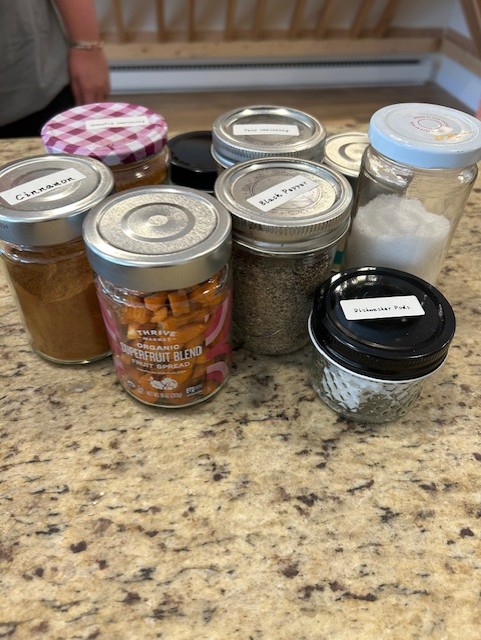
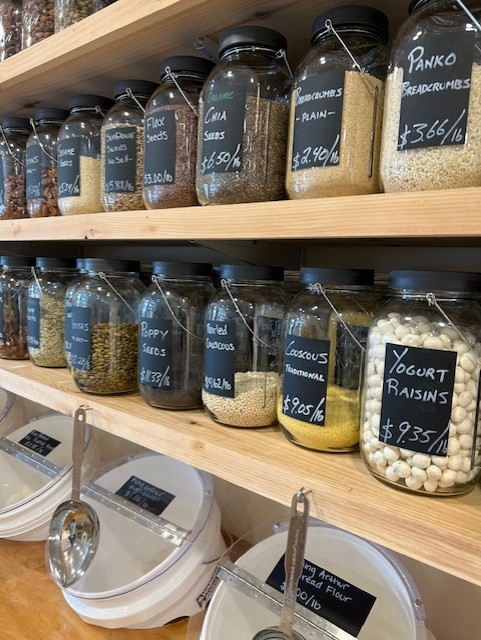
The Glass Jar is a refillery market in East Dennis, Massachusetts that offers a variety of pantry staples and novelty items for customers to self-fill into their own containers. Owner Meghann Lazott had a vision of opening a store for customers to get everything they needed without buying too much or too little, all while reducing or completely replacing single-use plastics. To make her vision a reality, she wrote a variance to be approved by her local health department, allowing the use of customer-provided containers and self-filling. Since all items at the Glass Jar are shelf-stable and do not need refrigeration, writing the variance for customers to bring and fill their own containers was a straightforward process. Customers may bring clean, dry, and sealable containers from home that are suitable for refilling. Upon arrival, the containers are visually inspected by employees, tared, and returned to the customers to self-fill using store-supplied clean scoops and funnels. This ensures contents from the bulk bins do not directly contact the containers. The Glass Jar washes, sanitizes, and air-dries the scoops and funnels after each use.
Meghann explained to RecyclingWorks MA, “When I got started, the first step was to talk to the health department. I asked ‘Can I do this? What do I need to do?’ It was a huge learning experience, and the first health department person I worked with was incredibly helpful. They said ‘we don’t see any problem with this’ and decided to treat me like a restaurant with two or three times a year inspections. Honestly, it was very easy for me because I had the backup of the health department. They want you to succeed within the guidelines of food code.”
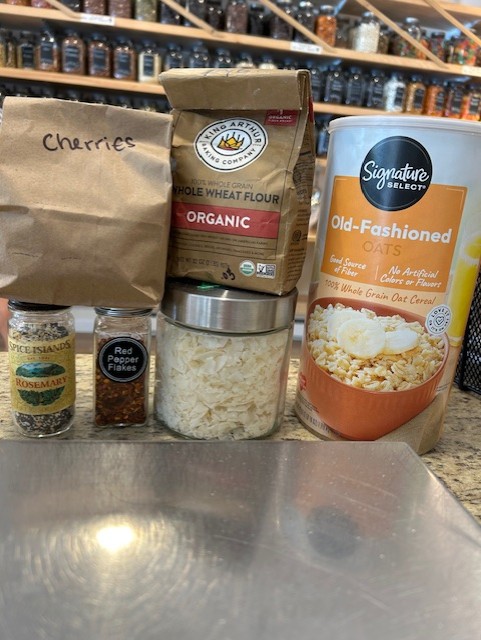
The Glass Jar is collaborating with Green Road Refill as of October 2025 to expand offerings to include refillable soaps, lotions, and beauty items. “We offer bulk pricing that you don’t have to buy in bulk amounts,” she shared. “We give people the opportunity to take control of how much they are consuming. On the surface, it’s all fun snacks and candy. We try to make it fun… and we are beating the grocery store on most of their pricing.”
The effort to write the variance was well worth Lazott and The Glass Jar team’s time.
“We’re so busy! We’re going to be open 7 days a week with expanded hours. It’s a new challenge and a good one!”
If your business is interested in offering the option of customer-provided containers, call RecyclingWorks MA at (888) 254-5525 or email info@recyclingworksma.com to get started.