RecyclingWorks in Massachusetts

Free, expert support to help Massachusetts businesses reduce waste and maximize recycling, reuse and food recovery opportunities.


Get Assistance Find a Recycler
ABOUT RecyclingWorks in massachusetts RecyclingWorks in Massachusetts is a recycling and food waste reduction program funded by the Massachusetts Department of Environmental Protection and delivered under contract by CET that helps businesses and institutions reduce waste and maximize recycling, reuse, and food recovery opportunities.

Tangible Success. Real Impact

This year focused on impactful initiatives
supporting reuse, food donation, and environmental justice communities.

300+
Businesses Served
800 tons
Recyclables Diverted
730 tons
Wasted Food Diverted

who we help

RecyclingWorks MA supports Massachusetts commercial entities that generate waste:

person in a kitchen

Businesses of All Sizes & Institutions

Restaurants, grocery stores, hospitals, schools, manufacturers, offices, assisted living facilities, hotels, and more.

Get Assistance

Haulers & Compost Site Facilities

Guidance to align processes, materials, and customer needs, including support to reduce contamination.

Get Assistance

Municipalities & Organizations

Support to encourage commercial waste reduction in your community through education, outreach, and direct assistance.

Get Assistance

how we help

RecyclingWorks MA makes recycling, waste reduction, and food recovery easier for busy owners, managers, and staff with clear, tailored recommendations you can act on.

Waste Reduction & Recycling Consulting

Improve operations, simplify sorting, and uncover potential cost savings with customized, actionable guidance.

Food Management

Reduce or repurpose food during preparation, identify surplus food for donation, set up efficient collection, and connect with donation or diversion partners.

Site Assessments

Virtual or in person assistance to implement programs through evaluating materials handling, customized signage, and staff training.

Waste Ban Compliance Support

We’ll walk you through requirements, timelines, and practical solutions aligned with Massachusetts waste bans. While we don’t assess or verify compliance, we can help you understand the guidance and put workable systems in place.

Start Here, Fill Out the Form Prefer To Talk? Call An Expert

Real Stories from Real Businesses.

See how Massachusetts businesses are reducing waste and recovering food with our help. 
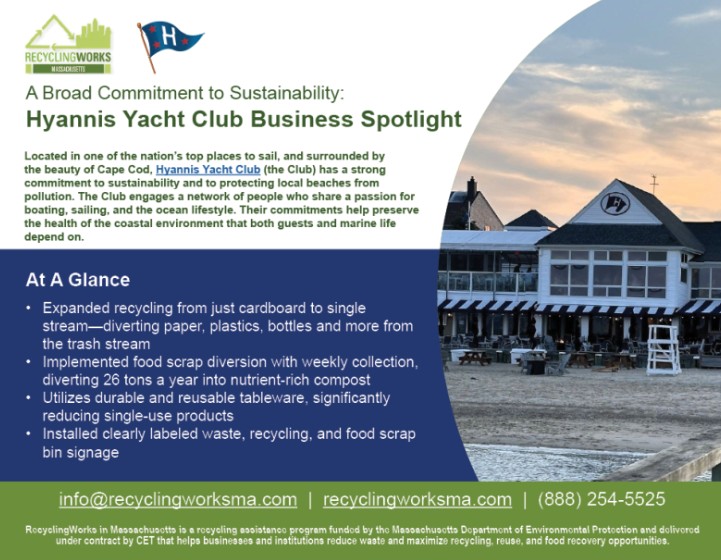
A Broad Commitment to Sustainability: Hyannis Yacht Club Case Study by RecyclingWorks Massachusetts
See how Hyannis Yacht Club reduced waste with waste separation techniques in this detailed case study by RecyclingWorks in Massachusetts. Learn how ocean stewardship has led this Massachusetts nautical hub to expand its waste diversion programs. Hyannis Yacht Club, in collaboration with RecyclingWorks Massachusetts, works to adopt zero waste principles and sets a strong example…
Ocean-Friendly Waste Reduction: Gorton’s Seafood Case Study by RecyclingWorks Massachusetts
Learn how Gorton’s Seafood reduced waste with sustainable practices in this detailed case study by RecyclingWorks Massachusetts. Explore innovative strategies for an eco-friendly seafood industry. Gorton’s Seafood, in collaboration with RecyclingWorks Massachusetts, implemented ocean-friendly waste reduction practices that set a new standard in the seafood industry. This case study explores their approach to sustainability, detailing…
Ecos Properties & Worleybeds
RecyclingWorks in Massachusetts presents case studies featuring Ecos Properties, a commercial real estate company that transformed a large-scale renovation project into an impactful reuse and recycling initiative, and Worleybeds, a mattress manufacturer and retailer with a strong mattress recycling program that diverts hundreds of tons of material from disposal per year.

What Business Have to Say

A woman smiling inside a restaurant while holding a sign that says “Join us! Choose 100% Green.”

Kay Masterson, Co-Owner, Johnny’s Luncheonette

It’s not like you’re doing anything that different. Instead of tossing it into one bin, they’re just tossing it into another. Honestly, it was easier than I thought it was gonna be, which is wonderful because not every change is like that

Patrick Worley, Vice President, Worleybeds Factory Outlet

Business and consumer culture is changing. People care and consumers notice. We need to take a hard look at what the future is going to be

Erik Dyson, CEO & Co-Founder, HandUp Mattress Recycling & Upcycling

[Businesses need to] make it easy for trained employees to get things right the first time and prevent contamination. Diverting [them] from landfills is commendable and also a great way to control cost

Explore Our Resources 

Access practical tools and guidance designed to help your business effectively reduce waste and recover food. 

Find a Recycler

Use our searchable tool to locate recycle service providers across Massachusetts.
Laptop displaying a recycling search tool with filters, business listings, and a map with location pins showing nearby service providers.
Quickly locate recyclers near you

Search by material, location, or business name

Frequently Asked Questions

Reducing waste lowers disposal costs, supports local donation and recycling partners, preserves disposal space, and helps reduce greenhouse gas emissions. Many businesses find opportunities to streamline operations and improve efficiency when waste is measured and managed intentionally. MassDEP has Solid Waste Master Plan goals to reduce overall disposal 30% by 2030 and 90% by 2050.

Any Massachusetts business or institution. 

Yes. Our consulting services, recommendations, and guidance are funded by the MassDEP so there is no cost to you. Recommended services may have a cost however we strive for cost savings or cost neutral solutions as waste is diverted into higher and better use streams.

No. We offer independent, customized guidance and connections, so you feel confident choosing solutions that work for you. 

Commercial food material diversion means keeping food out of the trash and managing it through approved pathways such as food donation (for edible food), animal feed, composting, anaerobic digestion, or other permitted processing. Businesses can reduce, donate, and divert material to help comply with the Massachusetts Commercial Food Material Disposal Ban. 

Many businesses find they can streamline operations, train staff more effectively, and reduce disposal costs when waste is measured and managed intentionally. Improved systems also make it easier to meet compliance requirements and reduce confusion for employees. Separating food scraps from trash can also improve the cleanliness and overall condition of the waste handling area. 

RecyclingWorks MA is a neutral, non-regulatory assistance program. Our role is to help businesses and institutions understand Massachusetts waste ban requirements and identify practical, best-practice approaches that fit their operations.

MassDEP developed RecyclingWorks MA as a separate resource to support education and improvement.

MassDEP conducts inspections and may issue notices or penalties when banned materials are found in disposal loads. Falling to recycle or divert waste ban materials can pose operational and compliance risks. Whether you are just getting started, responding to a notice, or strengthening existing systems, we provide no-cost guidance to help you make meaningful, workable improvements.

Waste Ban Materials 
Food 
Recyclables (paper, cardboard, plastics, metals, and glass) 
Construction & demolition materials 
Reusable items & donation materials 
Textiles 
Mattresses 
Organics and compost site operations 
And more! Let us know what you have and we’ll tell you how we can help!

Massachusetts first implemented disposal bans in the 1990s to keep valuable materials out of landfills and incinerators—such as paper, cardboard, glass and plastic bottles, jars, jugs, tubs, metal, major appliances, lead acid batteries and leaf & yard waste. Over time, the list of banned materials has expanded to include items like commercial food material, cathode ray tubes (old style tv’s), tires, wood, metal, certain construction and demolition materials, mattresses (including box springs), and textiles.
 
Waste bans have been added gradually as statewide infrastructure and viable end markets became available. The goal is to ensure materials are diverted to reduce pressure on Massachusetts’ limited disposal capacity. 
 
The Massachusetts Solid Waste Master Plan outlines future goals to expand banned materials, reduce thresholds, and reduce reliance on disposal.

As a result of the mid-term review of the Solid Waste Master Plan, MassDEP is proposing a full ban on commercial food waste in 2028 and a ban on residential food waste in 2030. To follow the developments, https://www.mass.gov/info-details/massdep-organics-subcommittee 

Source separation means keeping recyclable or recoverable materials (like food scraps, cardboard, textiles, or reusable items) separate from trash at the point where they are generated. This improves recycling efficiency, reduces contamination, and helps ensure materials can be donated, recycled, composted, or otherwise recovered. 

Ready to take action on waste reduction? 

Contact our team for free, customized assistance.

Get Assistance Call Us Now